A sound bar with surround sound transforms your living room into an audio powerhouse by delivering immersive, cinematic sound without the complexity of a traditional multi-speaker system. Modern soundbars achieve this through virtual surround sound algorithms, beamforming technology that bounces audio off walls and ceilings, or by including dedicated wireless rear speakers for true discrete surround sound. This streamlined solution significantly upgrades your TV’s built-in audio, providing clear dialogue, impactful bass, and a three-dimensional soundscape for movies and shows.
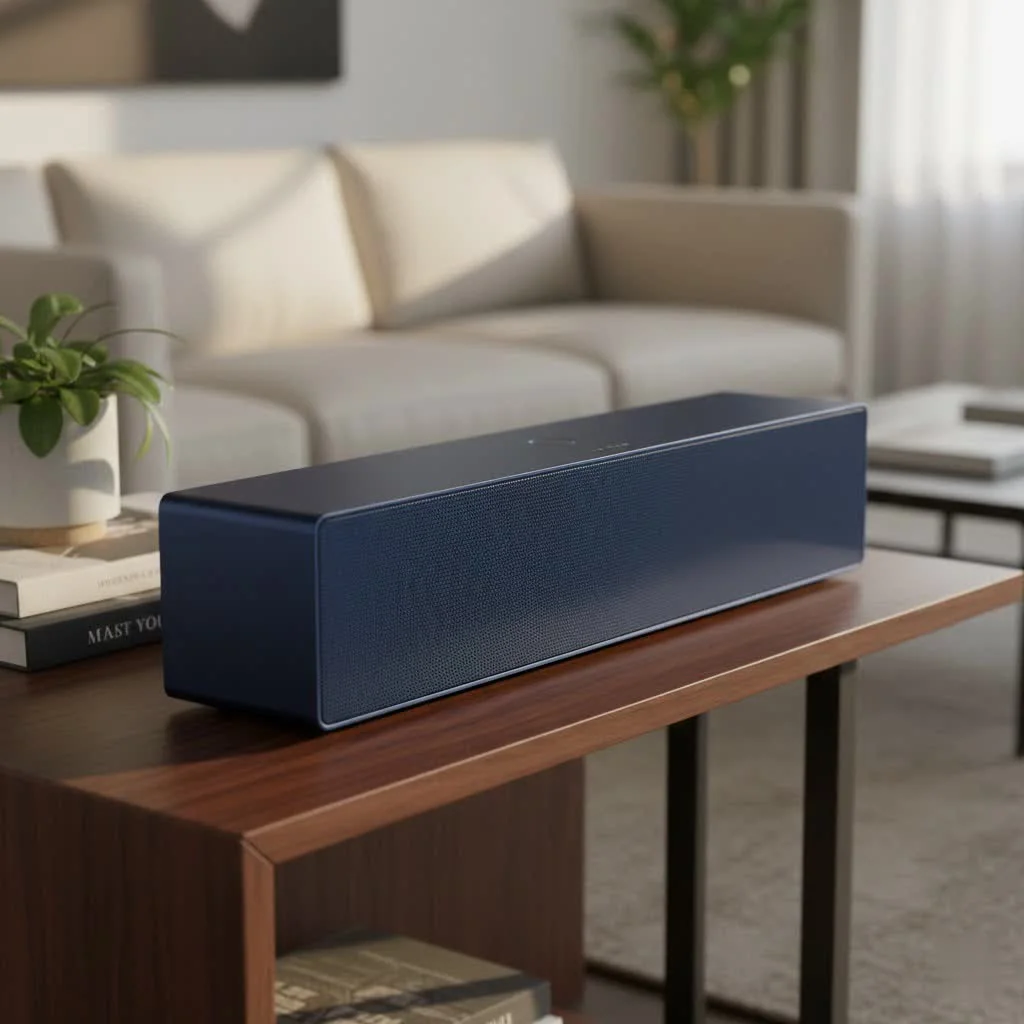
For years, truly immersive audio required an AV receiver and at least six different speakers. Today, advanced soundbars can deliver a surprisingly effective surround experience, from subtle atmospheric effects to overhead sounds. With technical terms like Dolby Atmos, 5.1.2 channels, and psychoacoustics, choosing the right one can be daunting. As an audio expert with over 15 years in the field, I’m here to demystify the technology and guide you to the perfect audio upgrade for your home.
How Exactly Do Sound Bars Create Surround Sound?
A single bar under your TV creating a three-dimensional soundscape sounds like magic, but it’s clever engineering. Soundbars achieve this effect in a few distinct ways, ranging from digital trickery to using room physics.
The Magic of Virtual Surround Sound
The most basic method is virtual surround sound. This technology uses sophisticated algorithms, often called Digital Signal Processing (DSP) and psychoacoustics, to trick your brain. By precisely manipulating audio timing and frequencies, these soundbars create the illusion that sound is coming from places without physical speakers. It’s an impressive enhancement over standard stereo, widening the soundstage to make audio feel larger and more enveloping, even if it’s not true, discrete surround sound.
Bouncing Beams: How Advanced Bars Use Your Room
More advanced models take this a step further with technology often called beamforming. These soundbars contain multiple, precisely angled drivers that project sound waves in specific directions, bouncing them off your side walls and ceiling.
As audio engineer David Chen notes, “Think of it like a professional pool player using the rails to sink a shot. These soundbars use your walls as acoustic reflectors. The audio processor calculates the precise angles needed to make sound arrive at your ears from the side, or even from above, creating a bubble of sound.”
This is the principle behind many Dolby Atmos and DTS:X compatible soundbars. They have dedicated up-firing speakers to reflect sound off the ceiling, adding a crucial height dimension that makes the experience dramatically more immersive. The effectiveness, however, can depend heavily on your room’s layout, ceiling height, and wall surfaces.
The Real Deal: Systems with Dedicated Rear Speakers
|
Our Picks for the Best Sound Bar in 2026
As an Amazon Associate I earn from qualifying purchases.
|
||
| Num | Product | Action |
|---|---|---|
| 1 | Sound Bar for Smart TV, 80W Soundbar with Bluetooth/ARC/Opt/AUX Connect, Auto Volume Boost, 3 Equalizer Modes, 2 in 1 Detachable Soundbar for TV/PC/Gaming/Projectors |

|
| 2 | Sonos Beam Gen 2 - White - Soundbar with Dolby Atmos |
|
| 3 | Sound Bar for Smart TV, 80W Soundbar with Bluetooth/ARC/Opt/AUX Connect, Dynamic Volume Boost, 3 Equalizer Modes, 2 in 1 Detachable Soundbar for TV/PC/Gaming/Projectors |
|
| 4 | ULTIMEA 5.1CH Surround Sound Bar with Subwoofer, Dolby Atmos, VoiceMX, BassMX, APP, 300W Soundbar for Smart TV, Home Theater Surround Sound System for TV, BT 5.4, Poseidon M60 (2025 Model) |
|
| 5 | Sony S100F 2.0ch Soundbar with Bass Reflex Speaker, Integrated Tweeter and Bluetooth, (HTS100F), easy setup, compact, home office use with clear sound black |
|
| 6 | Samsung HW-C450 2.1ch Soundbar w/DTS Virtual X, Subwoofer Included, Bass Boost, Adaptive Sound Lite, Game Mode, Bluetooth, Wireless Surround Sound Compatible |
|
| 7 | Sonos Beam Gen 2 - Black - Soundbar with Dolby Atmos |
|
| 8 | Sound Bar for Smart TV, 80W Soundbar with Bluetooth/ARC/Opt/AUX Connect, Auto Volume Boost, 3 Equalizer Modes, 2 in 1 Detachable Soundbar for TV/PC/Gaming/Projectors |
|
| 9 | MZEIBO Sound Bar with Subwoofer,120W Soundbar for Smart TV Surround Sound Home Theater System Bluetooth 5.3 Audio Compatible with ARC, AUX, Optical |
|
| 10 | VIZIO V-Series 2.0 Compact Sound Bar with Dolby Audio, DTS:X, Bluetooth V20x-J8 |
|
For the most authentic and impactful surround experience, nothing beats a system with dedicated rear speakers. Many premium sound bar with surround sound packages come with a main bar, a wireless subwoofer, and two smaller wireless satellite speakers that you place behind your viewing position. This setup provides true, discrete surround sound because each speaker receives its own distinct audio channel. This means when a car speeds from left to right and then behind you in a movie, the sound will physically travel from the front speakers to the rear ones, placing you directly in the middle of the action.
Decoding the Jargon: What to Look For When Buying
Walking into an electronics store or browsing online can feel like swimming in alphabet soup. Let’s break down the most important features to look for.
Understanding the Numbers: What Do 5.1 and 7.1.2 Mean?
You’ll see soundbars described with numbers like 2.1, 5.1, or even 9.1.4. It’s a simple code that tells you how many speaker channels are in the system.
- First Number (e.g., 5): This is the number of main channels at ear level. A “5” would typically include a center channel (for dialogue), front left, front right, surround left, and surround right.
- Second Number (e.g., .1): This indicates the presence of a subwoofer for low-frequency effects (bass). A “.1” means it has one. A subwoofer is crucial for feeling the rumble of explosions or the depth in a musical score.
- Third Number (e.g., .2): This is found on Dolby Atmos or DTS:X systems and represents the number of height channels, which are usually up-firing speakers that bounce sound off the ceiling. A “2” means it has two height channels.
So, a 5.1.2 system has five main channels, one subwoofer, and two height channels.
Must-Have Audio Formats: Dolby Atmos & DTS:X
These are the current gold standards for immersive, three-dimensional audio. Unlike traditional channel-based sound (like Dolby Digital 5.1), which assigns sounds to specific speakers, Dolby Atmos and DTS:X are “object-based.” This means sound designers can place an audio object (like a bee) in a 3D space, and the soundbar’s processor will intelligently use its available speakers—including the height channels—to recreate that sound’s position and movement accurately. The result is a far more realistic and captivating experience.
The Power of Connection: Why HDMI eARC is Essential
While soundbars offer various connections like optical and Bluetooth, the most important one to look for is HDMI eARC (Enhanced Audio Return Channel). A single HDMI eARC connection between your TV and soundbar can:
- Pass the highest quality, uncompressed audio formats, including Dolby Atmos and DTS:X.
- Allow you to control the soundbar’s volume and power with your TV remote.
- Simplify your setup with just one cable for both audio and control.
Don’t Forget the Bass: The Role of the Subwoofer
Some people, especially those in apartments, worry that a subwoofer will be too boomy or overpowering. However, a good subwoofer isn’t just about loud explosions. It handles the entire low-frequency range, adding depth, richness, and warmth to everything from movie scores to dialogue. A system without a sub can sound thin and incomplete. Most soundbar subwoofers are wireless and allow you to adjust their volume independently to blend perfectly with your room and preferences.
Smart Sound: The Benefit of Room Calibration
Every room sounds different. The same soundbar can sound boomy in a small, square room and thin in a large, open-plan space. To combat this, many mid-range to high-end soundbars include a room calibration feature. Using built-in microphones, the soundbar plays a series of test tones and analyzes how they reflect around your space. It then automatically adjusts its audio output to optimize the sound for your specific listening environment, ensuring you get the best possible performance.
Setting Up for Success: Getting the Most From Your System
Proper placement is key to unlocking the full potential of your sound bar with surround sound.
- The Main Bar: Place it directly below your TV, ensuring it’s not blocking the screen or the TV’s remote sensor. Keep it centered and as close to ear level as possible.
- The Subwoofer: Bass frequencies are less directional, so you have more flexibility. A common spot is in a front corner of the room, which can help reinforce the bass. But don’t be afraid to experiment; sometimes moving the sub just a few feet can dramatically improve its performance.
- Rear Speakers: If your system includes them, place them to the side and slightly behind your main seating position, angled toward the listeners. Aim for them to be at about ear level when you’re seated.
Is a Sound Bar with Surround Sound Right for You?
For the vast majority of people looking to drastically improve their TV’s audio without the cost and complexity of a full component system, the answer is a resounding yes.
Pros:
- Simplicity: Easy to set up, often with a single cable to the TV.
- Aesthetics: A clean, minimal look that doesn’t dominate the room.
- Huge Audio Upgrade: A massive improvement over TV speakers in clarity, depth, and immersion.
- Great Value: Offers a near-home-theater experience at a fraction of the cost.
Cons:
- Less Customization: Not as configurable or upgradeable as a traditional AV receiver and speaker setup.
- Power Limits: A high-end component system will generally be able to play louder and fill a very large room more effectively.
Your Cinematic Future Awaits
Upgrading from your TV’s built-in audio to a sound bar with surround sound is one of the most significant improvements you can make to your home entertainment setup. It bridges the gap between poor TV audio and complex home theater systems, delivering powerful, immersive, and cinematic sound in an easy-to-use package. By understanding the key technologies and features, you can confidently choose a system that will bring your favorite movies and shows to life in a whole new way.
Frequently Asked Questions
Can a single soundbar truly produce immersive surround sound effects?
Yes, a single soundbar can create a very convincing virtual surround effect using angled drivers and digital processing. However, for true, discrete surround sound where audio physically comes from behind you, a system with separate physical rear speakers is required.
Is a subwoofer necessary for a complete soundbar audio experience?
For a full and rich audio experience, a subwoofer is highly recommended. It handles the low-frequency sounds that a soundbar's smaller drivers cannot reproduce, adding significant depth and impact to movies, music, and games, often with adjustable volume.
What is the main difference between Dolby Digital and Dolby Atmos audio formats?
Dolby Digital is a channel-based format, like 5.1, that assigns specific sounds to specific speakers. Dolby Atmos is an object-based format that adds a height dimension, allowing sounds to be placed and moved in a three-dimensional space for a much more realistic and immersive effect, often using up-firing speakers.
How difficult is it to set up a soundbar system with wireless rear speakers?
Setting up a soundbar with wireless rear speakers is generally not difficult. On modern systems, the rear speakers and subwoofer almost always connect wirelessly to the main soundbar; you simply plug each component into a power outlet, and they pair automatically, making setup a breeze in under 15 minutes.
Do more expensive soundbars always offer superior audio quality?
Generally, a higher price point for a soundbar brings more advanced features, more powerful amplification, better quality drivers, and support for premium formats like Dolby Atmos. However, the best soundbar for you also depends on your specific room size and personal preference, so listening to a few models is always a good idea.
Set Up Your Sound Bar with Surround Sound
Properly place your soundbar, subwoofer, and rear speakers to optimize your home theater audio experience.
Place the main soundbar directly below your TV. Ensure it does not block the screen or the TV's remote sensor. Keep it centered and as close to ear level as possible for optimal dialogue clarity.
Bass frequencies are less directional, offering more flexibility for subwoofer placement. A common and effective spot is in a front corner of the room, which can help reinforce the bass. Experiment with moving the subwoofer a few feet to find the best performance for your room.
If your system includes dedicated rear speakers, place them to the side and slightly behind your main seating position. Angle them toward the listeners and aim for them to be at approximately ear level when you are seated to create an enveloping surround field.
Get our weekly buyer guide
Practical specs, not advice. Unsubscribe anytime.

I finally pulled the trigger on a soundbar with dedicated wireless rear speakers, and wow, what a difference! My old TV speakers just couldn’t cut it anymore, especially for action movies. The setup was surprisingly easy, and now I actually feel like I’m in the middle of the action. Definitely worth the investment for true discrete surround sound.
I was skeptical about virtual surround sound, but my new soundbar with beamforming technology really impressed me. It’s not quite the same as a full 5.1 system, but for my apartment, it’s perfect. The dialogue clarity is fantastic, and the bass is much more impactful than I expected. It’s a huge upgrade from my TV’s built-in audio.
I got a soundbar that advertised Dolby Atmos, and while it sounds good, I haven’t really noticed much in the way of overhead sounds. Maybe my room isn’t ideal for it, or I just expected more. It’s still a big improvement for movies and shows, but that specific feature didn’t quite live up to the hype for me.
After reading about the different channel configurations, I opted for a 5.1.2 system, and it’s incredible. The immersive soundscape for gaming is next level. I love how it handles subtle atmospheric effects, making everything feel so much more realistic. No more struggling to hear whispers in games!